Archive for the 'faith' Category
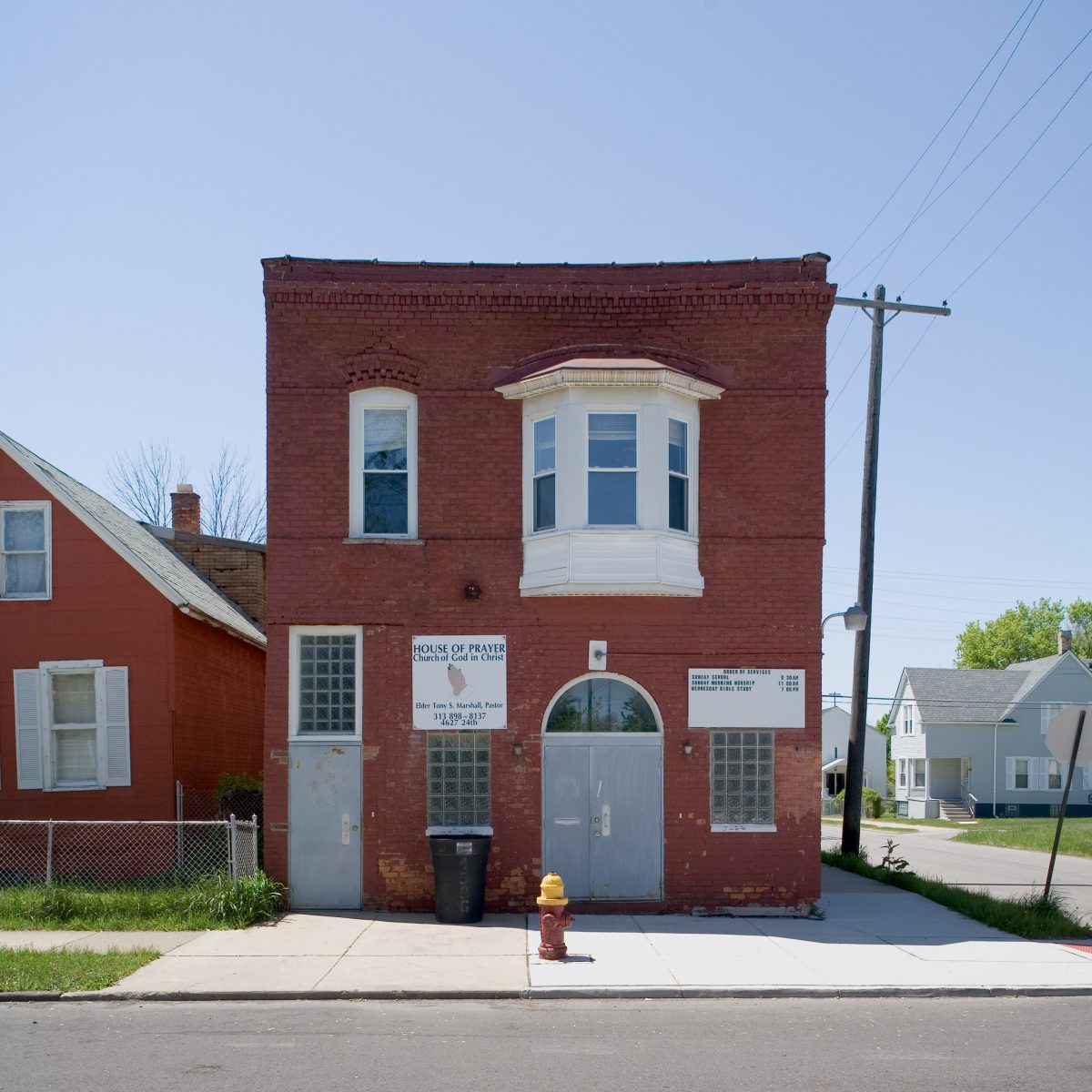
House of God
Published August 28th, 2010 in god, faith, worship, small churches, church, urban, fog, religion, Michigan, christians, photography, photos and Detroit. 0 CommentsMore Detroit vs. The Media drama, and What Detroit has, what Detroit’s losing, and what Detroit needs
Published June 23rd, 2010 in recession, news, housing, real estate, industry, faith, god, dysfunctional, arson, church, small churches, worship, moving, abandoned, jobs, economy, poverty, urban living, Michigan, religion, christians, urban, decay, fog, photos, photography and Detroit. 0 CommentsThis was supposed to have been posted a week, or so, ago. But thanks to my old job, four days out of town, jury duty, and a new job to start, none of what’s here is new. But, since I went to the trouble to write it, I’m posting it anyway.
Detroit vs The Media
The drama never ends for Detroit. NBC hates Detroit, and now ABC as well. ABC’s new crime drama set in Detroit has got some all bent out of shape once again. As always there were some interesting comments including:
“Why must the media prortray Detroit is such a bad light.” - Do we always have to ask this question? Seriously, is there any question as to why the media portrays the city the way that it does? Besides, did anyone complain about Law and Order making New York look bad, or CSI making Vegas look bad? Detroit deserves a break because it really is that bad? If only the media would give Detroit a break, surely things would improve. There were, as always, so interesting comments.
“Perhaps a chat with the directors of ABC would change their mind.” - Doubt it. Why do Detroiters always want to have a chat with the media about the way the city is portrayed? And, anyway how would that conversation go? Detroiter - “Will you to stop portraying Detroit in a negative light?” ABC exec - “No.”
“And I think the promo is wrong in saying that Detroit is the murder capital. I think we are up there, but more like number 3. New Orleans is #1″ - Yeah, take that ABC. They really ought to get their facts straight. Oh wait, according to ABC Detroit was the murder capital in 2008…hmm coincidence or conspiracy to paint Detroit badly?
“Was anything truthful said? Or is it Americas’ loss of integrity personified.” - Huh?
“I’m as sensitive to Detroit’s image as anyone, but I think that viewers will be able to decipher this as fiction.” - One might think so, but judging by reactions, that sentiment is not shared by many others.”
“So i can understand why ABC is doing a crime series set in Detroit.It’s about time. What took so long? I think I’ll send them some story ideas. I have many, too many, & these are all true, nothing make-believe.” - This one makes sense..
What Detroit Has
What does Detroit have, beyond high unemployment, high crime rates, and bitter defenders? Well according to POP City, Detroit has a few things Pittsburgh ( and presumably, other Rust Belt cities ) could use. Of course POP City is owned by Issue Media Group, which also just happens to publish Model D and Metromode as well, booth of which ardent Detroit boosters. Nonetheless, perhaps there are some good things that Detroit has, that other places could use. According to POP City, Detroit has:
The Greening of Detroit:
I can imagine that almost no other city in the United States has an organization quite like the Greening of Detroit, of course no other city has the amount of abandoned land that Detroit has. I like the Greening of Detroit and what they do.
Tech Town:
Tech Town is a great idea, and I hope some great things come of it. Bringing smart, creative, and innovative people together is exactly what Detroit needs. Technology may make it possible to work in isolation in Bad Axe, but in reality innovation comes from people pushing the envelope, and building on one another’s successes. This doesn’t often happen in isolation. It’s the reason Silicon Valley, Boston, and NYC keep creating new companies, and why they get so much of the investment dollars.
The M-1 Rail Project:
Detroit doesn’t have this yet. It is hoped that construction will begin before the end of 2010. Unfortunately, it takes several years to complete a section of rail through an urban area, and in an area that continues to lose population, it’ll will be difficult to make it happen.
Art:
Detroit does have this, and some good stuff at that. But projects such as the Heidelberg Project are products of an extreme situation that nobody wants. I really like the Heidelberg Project, but I’d rather not have the massive amounts of blight and abandonment that has to go along with it.
A Food Scene:
I can’t comment on Pittsburgh’s food scene, but Detroit’s food scene is decent, but not incredible. I love Slow’s but, even cities with lower populations, such as Denver and Portland, have better food scenes than Detroit. Five or six places…even a dozen good places aren’t enough for an area the size of Detroit.
Regardless of whether or not I feel this list is a good example of what other areas need or not (I don’t), the metropolitan Detroit area does have somewhere in the neighborhood of 4.5 million residents. That’s a significant amount of people, who could be customers, and employees or employers. Whether or not the area can capitalize on that depends on the decisions the residents, businesses, and politicians make over the next decade or so. If we were to look to the decisions of the past 40 years the outlook would be rather grim. Perhaps though, the next generation of policy makers can make better decisions than the last.
What Detroit’s Losing
Unfortunately this is an easy one. Detroit’s losing everything from people to money. What is really bad, is that metro Detroit is losing young college grads. I recently read this article about college education rates in Milwaukee, Wisconsin. Scroll down to the section titled, “By the Numbers”. My guess is Detroit doesn’t compare very well, even considering Milwaukee’s meager numbers.
What Detroit Needs
What Detroit needs is pretty much the inverse of what it’s losing, including a young, educated workforce, immigrants, Innovation, and, well…pretty much everything. Recovery seems to be a tricky, chicken/egg situation. Hi tech businesses locate where the talent is. Talent locates where the jobs are. Jobs are found where the hi tech businesses are. With each being a prerequisite for the other, how do you attract either one to Detroit? This is one of the arguments many make against authors such as Richard Florida. Reading what urban theorists such as Florida have to say make many feel that the”in” places, such as Chicago, D.C., and Silicon Valley, have already won. There’s no possible way to beat them if you take Florida’s theories without actually reading far enough. And that’s true to a certain extent. Nobody was able to beat Detroit as the automotive capital for 75 years or so, even with such bad management decisions. However, that didn’t stop Chicago, D.C., or Silicon Valley, and many, many other places, from thriving. Detroit doesn’t have to be Chicago, but it does have to be something other than the same old Detroit we’ve all known for far too long.
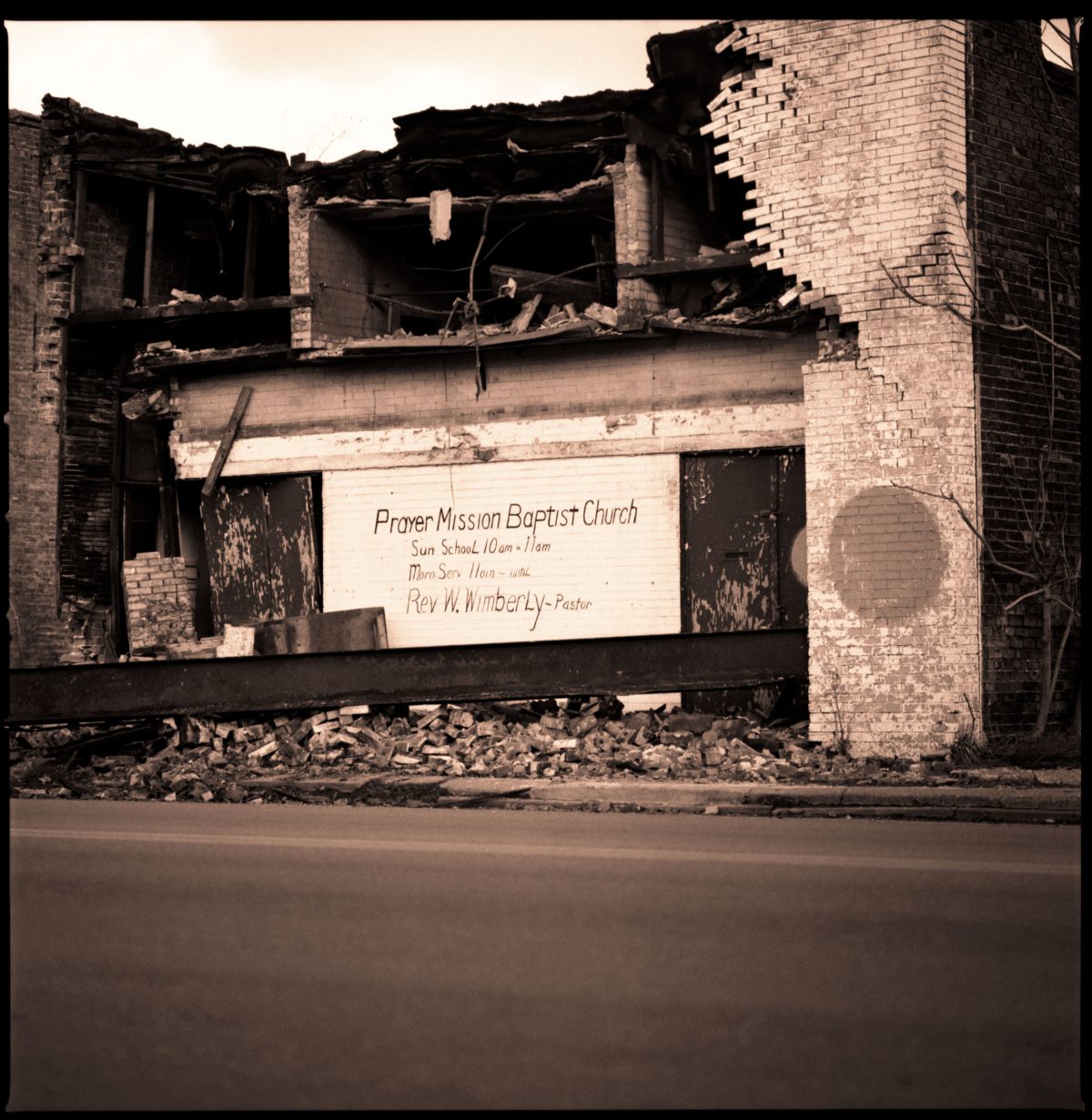
Prayer Mission Baptist Church
Published December 12th, 2009 in god, faith, decay, storefront churches, small churches, dysfunctional, church, urban, photos, urban living, Michigan, poverty, religion, photography, christians and Detroit. 0 CommentsWhen the wall to your church collapses onto the sidewalk and street, there’s no need to stop holding services. With a pile of bricks and an i-beam laying across the sidewalk and into the street, the name of the church, the pastor, and the service schedule was simply painted on a once interior wall. As singing and sounds of “praise God…” blared from speakers of a church across the street, pedestrians walking along the sidewalk either climbed over the pile or walked into the street without so much as a pause to consider the somewhat strange situation. It is a testament to what can be considered “normal” in the city of Detroit.
Faith Prayer Healing Temple Church of God in Christ
Published October 3rd, 2009 in faith, urban, god, small churches, church, morning, fog, Michigan, religion, photography, photos and Detroit. 0 CommentsCausality, fear, independent thought, and abandoned houses
Published September 23rd, 2009 in faith, are you kidding?, democrats, abandone houses, ignorance, abandoned, decay, rants, Michigan, photography, photos, urban and Detroit. 0 CommentsThe final topic of misconception is causality. I see assumptions of cause being used far too frequently as proof of an ideology or belief, when in fact no such causal relationship exists. Two things may exist at the same time, and yet neither caused the other. You would think, with all that we know, and the all that we have achieved, as a society, that we’d be able to move beyond ridiculous assumptions due to an assumed cause and effect relationship. But, of course, such discussions and beliefs would require reasoning, facts, proof, and testing. All of which are time consuming, and may very well prove the opposite of what we feel comfortable in believing.
From Merriam-Webster’s dictionary:
1 : a causal quality or agency
2 : the relation between a cause and its effect or between regularly correlated events or phenomenaYou also have to define causal, of course:
1 : expressing or indicating cause : causative <a causal clause introduced by since>
2 : of, relating to, or constituting a cause <the causal agent of a disease>
3 : involving causation or a cause <the relationship…was not one of causal antecedence so much as one of analogous growth — H. O. Taylor>
4 : arising from a cause <a causal development>One common statement in arguments, and online forums goes something like this: “Detroit is a shit hole, therefore liberals create shit holes,” or “Republicans give tax breaks to the rich, therefore Republicans hate the poor and middle class.” Unfortunately, or fortunately (depending on whether you’re using causality in your argument), “correlation does not imply causation.” In other words, yes, Detroit is a shit hole, but claiming it’s as simple as the political persuasion of it’s citizens or leaders, is nearly as baseless as saying flies are always on meat, therefore flies come from meat. This was once a belief (spontaneous generation), along with the earth being flat, and the sun revolving around the earth. Detroit’s big problem was, and is, a reliance on one gigantic industry to provide for all, as well as an avoidance of education, broken families, poverty, and a host of other things that reside just as often in Republican run states (see Mississippi and Louisiana).
In relation to causality, I’ve noticed a lot of blame for Michigan’s, and Detroit’s, current problems placed on one person. That person, of course, is Jennifer Granholm. I’m not here to defend our governor, but blaming more than 40 years worth of problems on one person? That’s dumb.
Jennifer Granholm may be the worst leader in the history of Michigan…or the best. It doesn’t really matter. Our current governor is not the cause of Michigan’s problems, and she won’t be the solution either. If anyone thinks Detroit’s problems began with Jennifer Granholm in 2003, they really haven’t been paying attention in the any of the last four decades. Instead of trying to find one person to blame, think about yourself. What have you done to prepare for the future?
The kind of simple causal argument that is often thrown about reminds me of this quote: “For every problem, there is a solution that is simple, neat, and wrong.” - H. L. Mencken
Along the same lines, I came across an article about creationism in Scientific American, and found this excellent response in the comments section:
“Causation and purpose are not rational subjects, neither is who what when where or why. The psychological imperative of memory creates a pattern of linear time experienced as reality, but limited by the perceptive abilities of the observer.
The result is that a human has an imagination, an ability to associate all memories, emotions, and sense perceptions with possible future consequences. This frees the cognate mind to choose potential results. It also causes the great majority of individuals to adapt whatever cultural behavior provides the most comfort and supports the identity, the personality of the individual.
The result is a social commitment to a virtual reality, in effect a reality of belief supported by communal ritual and agreement.
The belief process itself explains the ability to remain objective or to require dependence on family, tribe. or cultural ideas of reality, or virtual reality.”
I found this comment to be especially applicable to not only religious or scientific beliefs, but political, economic, and social beliefs as well. It’s more comforting to believe that those who don’t have what you have, don’t deserve to have what you have. “They don’t work hard”, we so often hear. “They want something for nothing”. In fact I think this was the feeling someone got from a previous post, where I talked about low skilled vs. high skilled labor. I’m sure I came off as sounding as though I felt anyone who hasn’t made the changes I’ve made deserves their plight. While I think that, yes, everyone needs to look out for their own well being, and if that means making large, difficult changes to their lives, than so be it. That’s life.
On the other hand, I’ve never said anything about the amount of hard work anyone puts into their own jobs, or lives, which brings me back to comments like, “they don’t work hard”, or “I work hard for my money”. Unfortunately, I don’t know many who don’t work hard for their money, and honestly, on some days, I’d like to work a little less hard for my own. But the point is that it’s, often, easier and more comforting to believe something with no evidence than it is to look for the truth. Particularly when your circle of influence holds the same beliefs. It’s easier to believe you don’t have a job, because of those damn immigrants, than to face the reality of our changing times. It’s easier to believe race is to blame for crime than it is to face up to racism, prejudice, limited opportunities, and general societal problems.
I don’t claim to not make assumptions myself, but I certainly try to keep an open mind, and to allow myself to change my mind when reasoned and factual arguments are presented. Unfortunately, I fear that our peers too often don’t like us to change our minds on certain topics. It’s not ok to decide that the political or economic belief you once held may not, in fact, be true. Our political, racial, ethnic, and religious allegiances require us to give up some of our independent thinking in order to fit in neatly. All we you have to do is look at politicians who have made compromises to get something they believe in done. What happened to John McCain when he crossed the aisle to work with several Democrats to pass bills he believed in? He was brandished a liberal, a label that stuck with him until he won his party’s nomination.
Socialism, and other isms, and of course, some abandoned houses
Published September 15th, 2009 in ignorance, abandone houses, dysfunctional, socialist, socialism, free market, capitalism, fascism, faith, are you kidding?, politicians, politics, Michigan, angry people, economy, abandoned, photos, photography and Detroit. 3 CommentsAs a continuation of my previous post about some ideologies that seem to be misunderstood by so many, I am writing about several different ‘isms’ that seem to be used frequently in discussions and arugments. I am not an expert in any kind of “ism”. I am simply interested in social, economic, and political theory and ideologies.
After writing this I came across an article in the Atlantic Monthly. It’s interesting, in that I see the type of agenda (both liberal and conservative) the article discusses far too often much of our media. I’m not in this to win. I don’t want to destroy anyone. I just want to encourage rational thought provoking discussion. It also made me think about what I’ve written in the past. Has it contributed to anger and hate, or has it contributed to a more admirable goal? Hopefully I can achieve the latter more often in the future.
From Merriam-Webster’s dictionary:
1 : any of various economic and political theories advocating collective or governmental ownership and administration of the means of production and distribution of goods
2 a : a system of society or group living in which there is no private property b : a system or condition of society in which the means of production are owned and controlled by the state
3 : a stage of society in Marxist theory transitional between capitalism and communism and distinguished by unequal distribution of goods and pay according to work done.Just putting the definition out there. You can make your own decision as to whether or not Obama is a socialist or not.
From Merriam-Webster’s dictionary:
1 : a political philosophy, movement, or regime (as that of the Fascisti) that exalts nation and often race above the individual and that stands for a centralized autocratic government headed by a dictatorial leader, severe economic and social regimentation, and forcible suppression of opposition
Recently Barack Obama has been accused of being a Fascist, which is of course silly. From Wikipedia, we can see that Fascists believe, among other things, that nations and/or races are in perpetual conflict whereby only the strong can survive by being healthy, vital, and by asserting themselves in conflict against the weak, and Fascism opposes class conflict, blames capitalist liberal democracies for its creation and communists for exploiting the concept. Fascists also believe in quashing all dissent and criticism of both the government, and the Fascist movement itself.
Fascists often believe in imperialism, Single-party states, Social Darwinsim, indoctrination, eugenics, and corporatism. For the most part these are not liberal ideals, and in fact, Fascism is close to the direct opposite of liberalism. It is pretty much anti-liberalism.
So to explain this in simple terms, was Obama a Fascist, the protesters at the recent town hall meetings would have been jailed or executed. Furthermore, Barack Obama is no more a dictatorial leader than George W. Bush was. Insisting on your way, if you’ve got the votes, and alliance to do so is not dictatorship. George W. Bush called it “Political Capital.” It’s not bipartisan, but it’s also not autocratic or dictatorial.
From Merriam-Webster’s dictionary:
: the body of political and economic doctrines held and put into effect by the Nazis in Germany from 1933 to 1945 including the totalitarian principle of government, predominance of especially Germanic groups assumed to be racially superior, and supremacy of the führer.
Considering the following from the Nazism Wikipedia entry, “Nazism is often considered by scholars to be a form of fascism,” and that fascism is the antithesis of liberalism, it would be difficult to truly believe Barack Obama could be compared to Hitler, as has been done recently.
From Merria-Webster’s dictionary:
1 : the quality or state of being liberal
2 : a often capitalized : a movement in modern Protestantism emphasizing intellectual liberty and the spiritual and ethical content of Christianity b : a theory in economics emphasizing individual freedom from restraint and usually based on free competition, the self-regulating market, and the gold standard c : a political philosophy based on belief in progress, the essential goodness of the human race, and the autonomy of the individual and standing for the protection of political and civil liberties; specifically : such a philosophy that considers government as a crucial instrument for amelioration of social inequities (as those involving race, gender, or class) d capitalized : the principles and policies of a Liberal partyLiberalism has got to be one of the big surprises for many. I would think approximately half of the politically active in this country would hate to be called “liberal,” when in fact the U.S. was founded as, and still is, a liberal nation. The Declaration of Independence states: “all men are created equal; that they are endowed by their Creator with certain unalienable rights; that among these are life, liberty, and the pursuit of happiness; that to insure these rights, governments are instituted among men, deriving their just powers from the consent of the governed.” Furthermore, the free market, so beloved by conservatives, is a liberal ideal. Of course there are different varieties of liberalism, but with a few exceptions, that is what we really have in this country. I think it’s possible to see policies in both parties that arguably violate the ideals of above quote. Furthermore, most of the political fighting currently going on is about different varieties of liberalism.
From Merriam-Webster’s dictionary:
: an economic system characterized by private or corporate ownership of capital goods, by investments that are determined by private decision, and by prices, production, and the distribution of goods that are determined mainly by competition in a free market.
There are many different forms of capitalism. One of the debates on capitalism of late is whether or not Keynesian economic theory should be used at this time, or whether or not we should continue to put our faith in the Chicago School of thought, based on neoclassical economics, which many blame for the current economic mess. One of the big flaws in neoclassical thought is the belief that people make rational decisions resulting in rational markets, and pricing. The obvious lack of rationality leads many to behavioral economics, which studies emotional factors involved in decision making.
Once again, from Merriam-Webster’s dictionary:
: an economic market operating by free competition
This is such a simple definition, and something that we have probably never truly had in this country, contrary to many who argue that we are only currently straying from it. I would argue that we’ve had a mixed economy pretty much since the country’s inception. Although, corporations often claim they like competition, they usually don’t. Hence they often lobby our politicians for protectionist legislation (tariffs on light trucks and SUVs, and more recently, tires), restrictions on ownership (such as radio and television frequencies), and other such government interventions to give a competitive advantage to specific industries or companies.
Grace Fellowship Baptist Church
Published July 5th, 2009 in worship, god, small churches, church, highland park, faith, urban, religion, Michigan, photography, photos, morning and Detroit. 2 CommentsNew Life Non-Denominational Church
Published March 13th, 2009 in worship, god, small churches, church, snow, faith, urban, religion, Michigan, photography, photos, winter and Detroit. 0 Comments25th Street Church of God in Christ, and Kwame gets a job
Published February 12th, 2009 in god, faith, worship, storefront churches, church, small churches, abandoned, decay, religion, Michigan, christians, photography, photos and Detroit. 0 CommentsJust in case you ever wondered, or speculated about the relationship between big business and politics, here’s an article that will only confirm what you thought. Not that I believe we should deny people of second chances, but really, who would hire a convicted mayor?