Archive for the 'urban living' Category

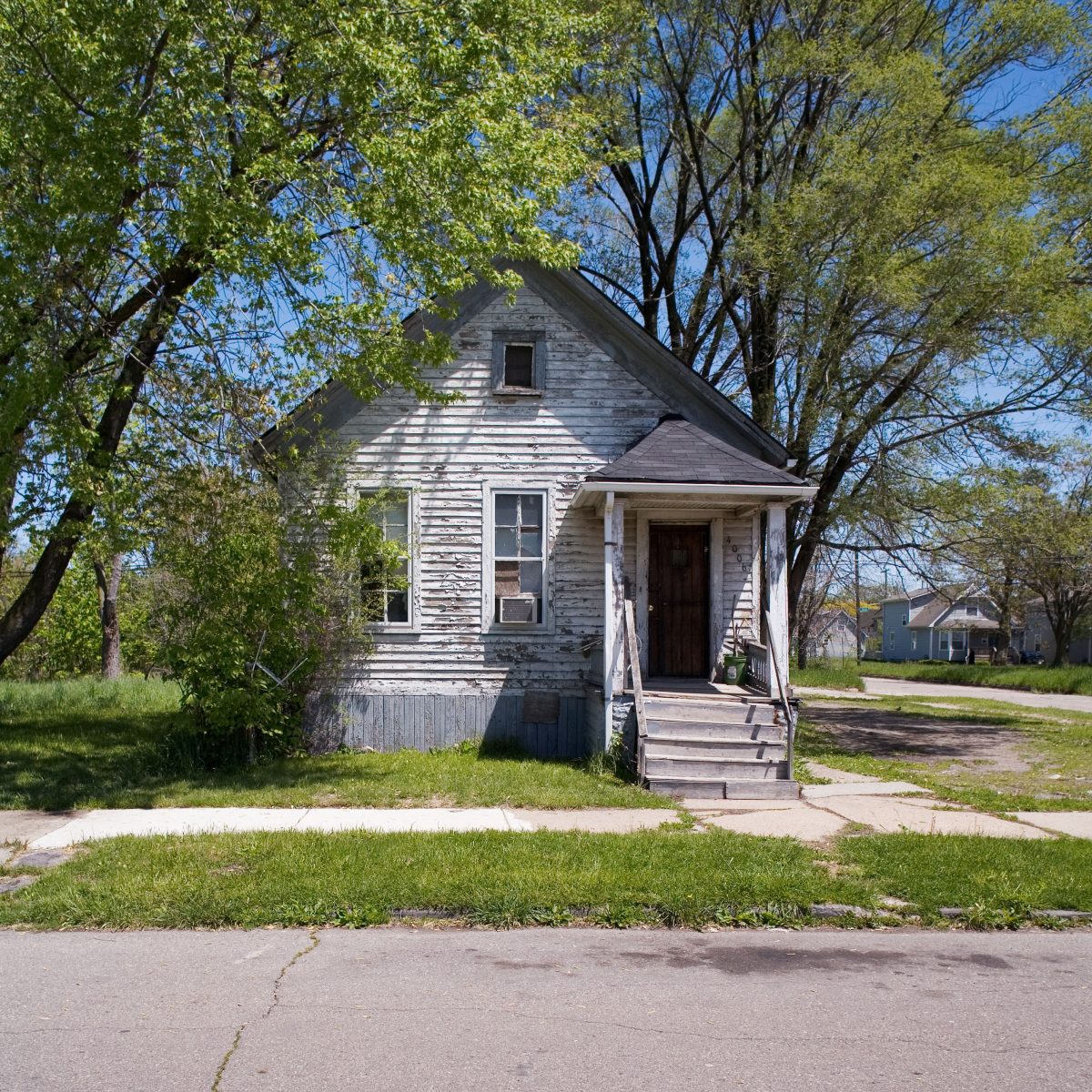
Detroit’s abandoned house of the week

07150802_05.jpg

Who understands how Detroit needs to change?

01200602_09.jpg

After living and working for the past two years in D.C., and Denver, Colorado, coming back to the Detroit area is a real eye opener. What was once a maddening and frustrating place to live is now just plain depressing. With the real unemployment rate estimated to be near 20% for the state, and a ridiculously high 50% for the city of Detroit, still falling real estate values (down 40% in my area, and including our house), a crumbling infrastructure, financially strapped municipalities and school districts, and a apparent 50% commercial vacancy rate (just judging by what I can see..), the metro area seems to continually worsen. Each time I come back it seems that things couldn’t get worse (even though I don’t believe the area’s hit bottom yet), yet it always does.

Living in the area, one becomes accustomed to things residents in most other areas would never imagine. Roads that get complaints in other areas, metro Detroiters can only dream about. The public transit that others complain about being crowded or expensive, doesn’t even exist here. Same with the practically non-existent bike lanes. In Denver I ride my bike everywhere, only getting in the car to make longer distance trips. It’s something that I found to be unacceptably difficult here in southeastern Michigan. When I did make a trip by bicycle here, I was that strange person riding their bike on the road carrying grocery bags; presumably some poor sap who’d had his license taken away, or who didn’t have enough money for a car. In Denver, I’m just one of many using a bicycle for, believe it or not, transportation. Imagine that… Our neighbor here in metro Detroit would drive one block to buy cigarettes.

02050401_12.jpg

Driving around metro Detroit, it’s rare to see more than one or two people out getting exercise of any kind. In Denver it would be rare to see less than a dozen people exercising on my two mile ride to work. The weekly Wednesday night cruiser ride in Denver attracted up to 850 riders on a single night this past summer. Of course one has considering how many other options there are for socializing, entertainment, and outdoor activities. On any given week there will be rides, runs, creative Meetups, art openings, and just about anything else an active person under the age of 95 might enjoy. I know some of these things exist in metro Detroit, but the often long distance between them isn’t just inconvenient, but a huge waste of time, and dangerous when you consider all of the different highways one would have to travel to get from, say, Royal Oak to Ann Arbor on a weekday evening.

I have a point, beyond yet one more rant about the area. And the point is this: does anyone, who hasn’t left, or doesn’t want to leave, understand what needs to change about the metro area? Everyone knows that Michigan needs jobs. But I get the feeling that many who remain believe that those who left were weak, or quitters, or don’t like hard work. Those “quitters” who left the state, left because they had other opportunities…better opportunities, and most likely a chance at a better lifestyle. They didn’t leave because they weren’t up for a challenge. If an area offers jobs, and “opportunities” rooted in the past, and another area is embracing the future, why would I choose that challenge? If you can be on a better team, who wouldn’t choose it? Sure, some would rather be a big fish in a small pond, but this particular pond keeps getting smaller, and dirtier.

The point is often made that the area needs to bring back manufacturing jobs. I wouldn’t argue that manufacturing jobs…heck any jobs, would be good for the area. But maybe what the area really needs is to face reality. Metro Detroiters need to adapt to changing times. An education may be a good place for many to start. The claim is often made that metro Detroiters are scrappy, gritty, and hard working survivors. What mid-west city doesn’t believe that? The question is, what do survivors do when there old way of doing things doesn’t work anymore? They change their way of doing things. What did metro Detroit do when it was obvious the ways of the past were going to end soon? Nothing. Detroit made pretty much all of the same mistakes Pittsburgh has made, but unfortunately, unlike Pittsburgh, Detroit’s had very little of the fortuitous investments in other industries.

The question that should be asked, that often isn’t, is why have our young and highly educated citizens been leaving for decades? If the question was asked of every one of them, that has left the state, one would get a variety of answers from jobs to lifestyle. If you were to ask what it would take to get them to come back to metro Detroit, the answers would be equally varied, but I doubt many want to come back for traditional manufacturing jobs. Nor did many of them leave because of a lack of traditional manufacturing jobs. As a friend said the other night, “the state is a storefront. Why would anyone want to come in?”

01200602_03.jpg

When time Magazine offered advertising space for a campaign designed to draw this very demographic to southeastern Michigan, they asked five large agencies to answer the question, “If I’m young, talented and creative, and open to all kinds of opportunities, why Detroit?” Take a look at the ads… My personal opinion is that these ads do a better job of answering, “if I’m young, talented and creative, and open to all kinds of opportunities, why leave Detroit?” The ads do a great job of pointing out the disconnect that exists between those who have lived here a long time, and made lots of money here, and those of a younger more mobile generation. Outside of the suburbs of Detroit, who cares about Kid Rock? It really makes me wonder, if these people even understand what types of music the target demographic listens to? I can tell you, it’s not Kid Rock. Not a single one touched on any compelling reason for someone from outside of the area, to relocated here. Why are we even asking the old guard how to attract a new generation of creative, enthusiastic, and highly motivated entrepreneurs and creatives? L. Brooks Patterson still wants to stake metro Detroit’s future on the widening of I-75 from 8 Mile to M-59. MDOT and SEMCOG still seem to believe all transportation should be done in an automobile. No bikes, no trains, no walking…again that’s for the Third World poor, such as those in New York, Chicago, Atlanta, San Francisco, Portland, Denver, London, Brussels, and Toronto.

The morning after I arrived back in metro Detroit, we watched part of a round-table discussion on a local news show. The topic was, of course, about the area’s future. It appeared that not one of the participants was under the age of 60. Not that those over 60 have nothing to contribute. But asking only those who lived through a very different time period how we should proceed into the future misses the point entirely. We are in this situation because we (they) thought that what worked in the past would surely work in the future. If it was good enough then, it’s good enough now. Needless to say, watching did not make me feel very encouraged about the future of metro Detroit. Does anybody here, in any leadership position, with any power, or with money, get it yet? Do they understand the real issues? Do they know what it’s going to take to bring people back, or to make them stay?

Updated Map of Abandonment


View Detroit Photos in a larger map

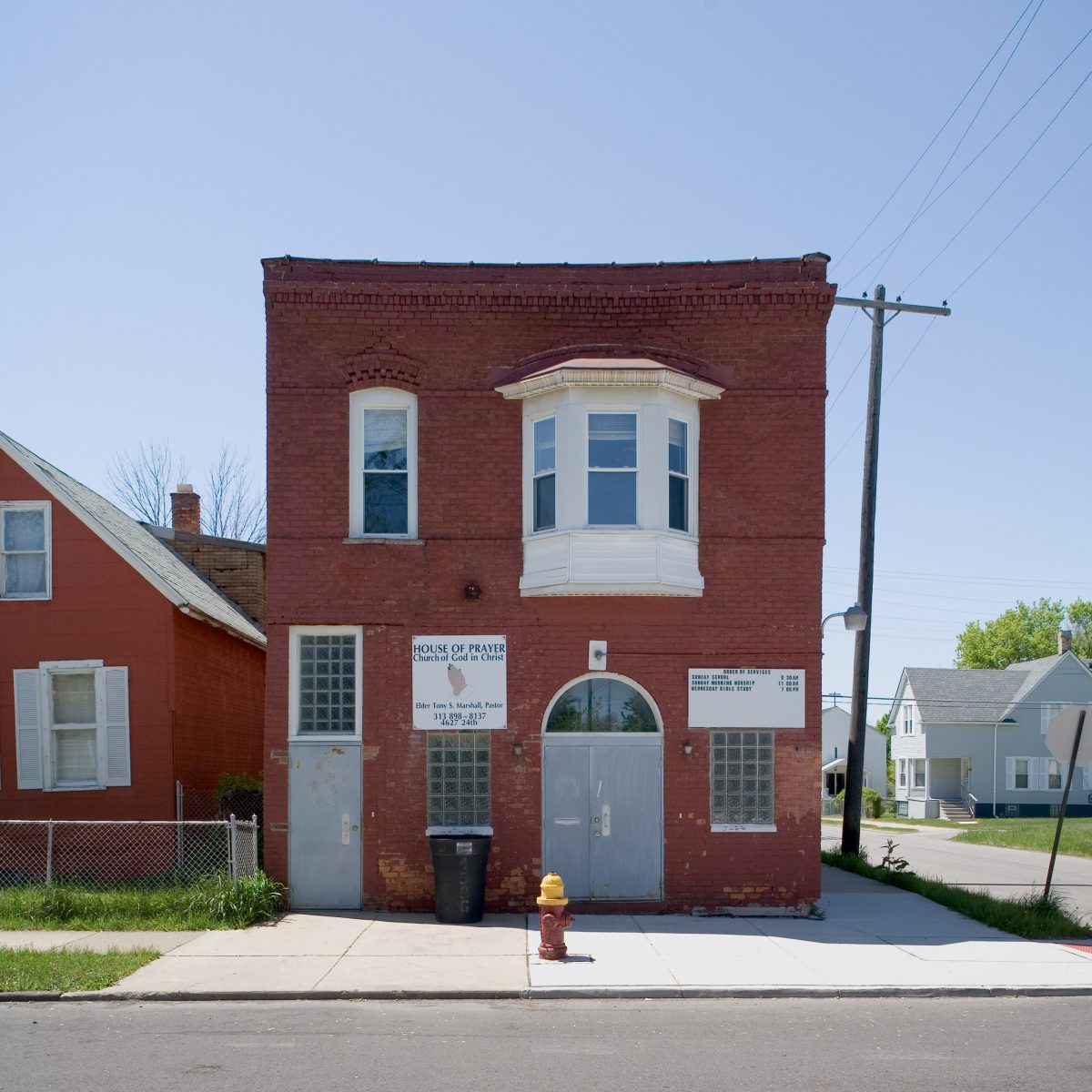
Prayer Mission Baptist Church

06150202_07.jpg

When the wall to your church collapses onto the sidewalk and street, there’s no need to stop holding services. With a pile of bricks and an i-beam laying across the sidewalk and into the street, the name of the church, the pastor, and the service schedule was simply painted on a once interior wall. As singing and sounds of “praise God…” blared from speakers of a church across the street, pedestrians walking along the sidewalk either climbed over the pile or walked into the street without so much as a pause to consider the somewhat strange  situation. It is a testament to what can be considered “normal” in the city of Detroit.

Health care can’t save Michigan, or I told you so part 3…Michigan’s future, and some photos
lowry.jpg

In May of 2008, I read an article regarding the expansion of the area’s hospitals, and the growth of the health care industry in general.  At the same time, I also wrote about how I had viewed this as a potential problem for a long time. The idea, at the time, seemed to be that Michigan’s, and in particular, metro Detroit’s, economy could be saved by health care. And, so the growth of the local hospitals could put more people to work. Former automotive employees could be retrained to work in the health care industry. Best of all, the health care industry was largely immune to the ups and downs of the economy. People always need health care! And with our aging population, we’d have an ever increasing supply of patients.

What wasn’t often mentioned was that Michigan, and again, metro Detroit in particular, was losing population at the same time that the hospitals were expanding. The problem with the health care as savior plan, was no different than the belief that the housing market, or the commercial real estate markets would keep growing despite a declining population. From my conversations with industry “experts” and from reading and watching the local news, it was obvious that many people, whom I had generally assumed knew more than me, couldn’t imagine a Michigan any different from the one they were living in in 2005 or so. The real estate markets were booming, the health care industry was booming, and the Big Three seemed to be doing not to terribly bad (other than maybe Ford). If one only looked at the surface, things may have looked so-so in Michigan, but if you were to have looked a little deeper, things looked like they were going to become downright horrible. The population had been stagnant or declining for a while. Michigan was one of the few states in recent history with this distinction. We were far too heavily dependent on an ailing industry with a broken business model, whose employee’s pay rate was not based off of market forces in any way, and whose management teams couldn’t seem to see past the ends of their noses, or a least past the next quarterly profit report. And we kept on building, and moving further from Detroit, using used tax payer money to help build infrastructure for new developments, while our old infrastructure crumbled. It angered at least a few of us, that no one seemed to be able to (or at least didn’t want to) see that a declining population whose economy was based on one broken and declining industry, and whose current investments were being made on new, and largely unneeded infrastructure, was doomed to failure, and soon.

In my business, when I asked questions about the, seemingly huge, number of new housing developments being built in the middle of nowhere, I was constantly told things like,  “our projections show that we can build like this indefinitely”, and “as fast as we build them, people buy them”. Were are these people coming from, I would ask. The answer was usually something like, “a lot come from Detroit, or from older suburbs”. Apparently, no one thought to follow this logic to the end of the line. If Detroit has been losing population for 40 years, and people move from Detroit to Dexter, who is buying the house in Detroit so that the purchase in Dexter can be made? People were buying houses in Detroit at the time, but obviously less than were leaving Detroit. The problem was simple. You can not expand the number of houses if the number of people is going down, with out driving prices down. But what was such an obvious sign of trouble at the time, is that prices were rising, and people were sure they would keep rising.

502154824_44405dc3cd_o.jpg

So Michigan had a declining population, dependent on a downsizing industry with a broken business model, that had already been laying off large numbers of employees for years, an over saturated residential and commercial real estate market, and of course a largely under educated work force. But, we need not fear because the health care industry was going to save us. We’d all become doctors, nurses, assistants, or administrators, and we could just all be at the hospital all the time, either taking care of someone, or being taken care of by someone else. It’s the logic that seemed to be used by the Big Three for a while. For quite some time, almost all television advertising was directed toward their own employees. Who advertises to themselves? I’ll pay you, and you can then give it back to me in exchange for the thing you just made, that I paid you for. Maybe if we just make a chain letter, and send it to all of our friends, we can all get rich!

Unfortunately, a market based economy requires more than one or two industries to work. And so, it was always obvious, that unless something fundamental changed in Michigan, that we couldn’t depend on the health care industry to save us. As it turns out, the health care industry isn’t immune to downturns in the economy after all. It should have been obvious all along. If you are out of a job, or have no insurance, do you put off medical care and procedures? Of course. And if there are less people in the state, are there less potential patients? Of course. Michigan, like any other state, can’t depend on any one industry to keep the economic engine running. It takes a progressive, and diversified economy to be successful. No one knows for sure what the next big industry will be. Who predicted Google? At the time, most people thought search engines couldn’t possibly make money, and yet online advertising, has been a growth industry for years. Trying to create a plan for the future, based on the past, is unlikely to work. Sure the past holds lessons to learn from, but the future remains unknown. What Michigan needs to do is to put a priority on education, entrepreneurship, and quality of life. Of course Michigan’s broke, so it’ll be very difficult for the government to do what is needed, but the real change needs to come from the citizens who live there. If Michigan becomes a holdout of stodgy, grumpy, and angry citizens, that resists any change at all costs, then the downhill slide will continue for decades more. But if the cheap living can attract a new younger and more progressive generation, then Michigan may have a chance.

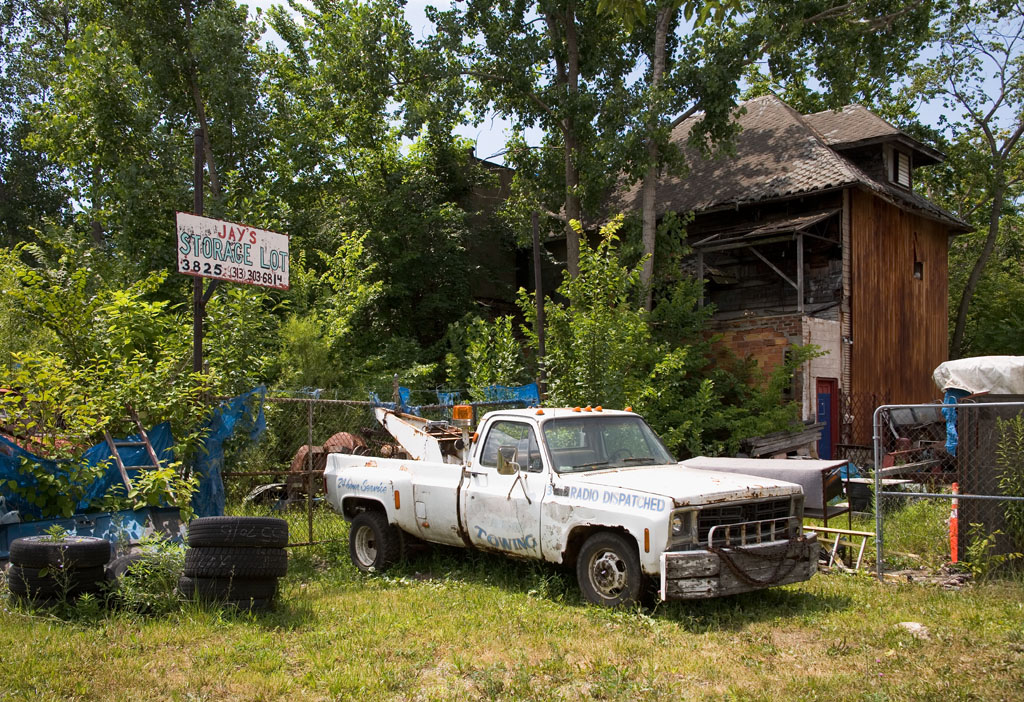
Jay’s Storage Lot

07202009_0113.jpg

Where Detroit ends…

Can you tell which side of the map is Detroit and which side is Grosse Pointe?


View Larger Map

The abandoned house of the week, and G.M. finally files for bankruptcy

12150404_03_xl.jpg

The big news out of Detroit this week is G.M.’s bankruptcy filing. The fourth largest bankruptcy in U.S. history was a long time coming. There’s already plenty of analysis on the reasons for G.M.’s failure available for reading. Most of the reasons have been far too easy to figure out. For most of us, cars are like many other parts of our lives. They are necessary, expensive, and we just want them to work. For the vast majority of us, cars have become simply another commodity. P.J. O’Rourke feels that the romanticism related to automobiles is gone; that Americans have fallen out of love with cars because of “bureaucrats, bad taste and busybodies”. Apparently cars aren’t “sexy” enough anymore. Has he seen or driven a Corvette, Viper, or GT? Unfortunately it’s an over simplified analysis by someone who grew up in the Big Three’s glory days of fins, muscle cars, drag racing, cruising, drive-ins, and 427 big block’s.

A more thoughtful analysis would be something along the lines of this article in USA Today. G.M. isn’t headed for bankruptcy because Americans don’t love cars. G.M. is headed for bankruptcy because they failed to position themselves for the future. Toyota and Honda haven’t been so successful because they make muscle cars, or sports cars of any kind, for that matter. They have been successful because they’ve made reliable, efficient, and price competitive cars that we wanted to buy. Consumer’s desires and needs change. Failure to supply your customer with what they want or need, at a price that is competitive with the rest of the market, is an indication of bad management.

Meanwhile, Detroit, and along with it Michigan, continues on a downward trajectory. Besides G.M.’s, there have been over 137,000 personal and business bankruptcies in Michigan over the past three years. The layoffs and plant closings resulting from the big G.M. bankruptcy will have a devastating effect on communities such as Pontiac and Orion, Michigan, both on the list of of planned closures.

Additionally, The One D Scorecard came out, and one can guess how Detroit did. Even though the Free Press says, “Detroit area receives a mixed report in survey,” the results were hardly mixed. Years of ignoring glaring problems, and dysfunction, by the industry, our political leaders, and much of the general population, have lead to the problems Detroit, Michigan, and the U.S. auto industry face today.

More of the same, or, why I continue to beat a dead horse…

metropolitan_night.jpg

I know I say the same things over and over. I guess I just feel I can’t say them enough. One of my favorite topics is the need to make the Metro Detroit area an attractive place to live. The usual xenophobic reaction is to resist any kind of change.  The typical mindset seems to be something like the following: If something worked 75 years ago, it’s got to work now. We didn’t need mass transit, bike lanes, or parks then, so why would we need them now. In fact people only go to cities for jobs, right? So we need to get some big corporation to relocate to our sad, depressed area, and give us jobs.

In reality, highly educated, creative, young people go where they want to go. And guess what? They don’t want to go to Metro Detroit. They want to go to cities they may actually enjoy living in, not just one that provides a job. A good urban area can, and usually does attract educated, creative, and entrepreneurial young professionals, so important to economic growth. And young, creative, educated types start companies, and create jobs. Corporations are also much more likely to locate where they can pick from a large qualified workforce.

The metro area, and Michigan as a whole, has not been very forward thinking. In fact it’s pretty much been in reverse, while the vast majority of the country was in drive. Now, believe it or not, G.M. is planning to cut even more white collar jobs,  we are having to loan G.M. $4B more, GMAC is getting a $7.5B loan, and the automotive industry’s pension funds appear to be on life support.

10150302_08a.jpg

And to top it all off, Detroit’s got an image problem, largely due to the darn media. Constantly painting Detroit in a bad light; how could they? If only they new the truth; it’s a safe city, with lots of job opportunities and a bright future… Heck, even I am getting hate messages. Apparently I am a “disgusting human being” for taking photos of abandonment, and I surely “could’ve chosen a different subject matter.” Shoot the messenger. Always a good idea. In fact maybe if we say, “Detroit is good enough. Detroit is smart enough, and gosh darn it, people like Detroit”, maybe the abandonment and corruption will magically vanish, jobs will appear, and the economy and unemployment won’t be the worst in the nation anymore. Maybe I can pretend my house is worth more than my mortgage too.

Detroit does have a future of some kind. Most likely though, it’ll never look like it did 4o years ago. It’ll almost certainly be something very different. Hopefully, at the very least, it’ll look very different than it does today. Some possibilities include urban farming, green spaces, giving away land to entrepreneurs and urban villages. It’s obvious that Detroit can’t provide traditional services to the area it currently encompasses. It is time for a change.

Finally, while I feel very bad for the subject of this story, you just have to ask, “what were you thinking?” or “were you thinking?” It’s not like the Metro Detroit areas outlook suddenly went from promising to bleak overnight.

The Abandoned House of the Week

07150801_16.jpg